


Ampoule Degradation
— Active ingredient stability during repeated opening
Every time an ampoule is opened, a chemical event occurs. Why oxidation, hydrolysis, and capsule degradation are often mistaken for skin acclimation — and how to spot the difference.
- Oxidation, hydrolysis, photolysis: How active ingredients become unstable during repeated opening
- Four patterns of manifestation: How active ingredient degradation becomes visible in ampoules
- Formulation resilience and application routine: What closes the stability gap in practice
- Frequently asked questions
Anyone who uses active ingredients over several weeks is familiar with the phenomenon: the first ampoule feels potent, the third one seemingly less so. Whether this subjective impression corresponds to real degradation of the active ingredient or is due to the skin's acclimation effects can only be answered by understanding what actually happens during each opening process. Ampoule formats in particular — concentrated single-dose containers without an integrated pump system — are the focus of these formulation science considerations.
In cosmetic chemistry, active ingredient stability is not a static property. It is a process influenced by exposure to oxygen, temperature fluctuations, light exposure, and the repeated introduction of endogenous contaminants. Compounds that are particularly sensitive to oxidation, such as vitamin C, unsaturated fatty acids, or certain polyphenols, react to every contact with air with measurable degradation kinetics. The question is less whether an active ingredient degrades — it usually does — but rather how quickly, under what conditions, and what this means for your application.
Oxidation, hydrolysis, photolysis: How active ingredients become unstable during repeated opening
Every time an ampoule is opened, ambient air enters the headspace of the container. This process initiates or accelerates three central degradation pathways, which are well documented in pharmaceutical-cosmetic stability research.
Molecular oxygen (O₂) reacts with reduced active ingredients such as L-ascorbic acid, unsaturated fatty acids, or polyphenols. The reaction often follows autocatalytic kinetics: once peroxides are formed, they accelerate further degradation. In glass ampoules with air exposure, research shows that the concentration of L-ascorbic acid can drop significantly within 48–72 hours at room temperature. Transition metal catalysts like copper or iron ions — even in trace amounts from packaging materials — significantly amplify this effect.
Condensation and finger contact during opening introduce moisture and endogenous enzymes into the formulation. Ester compounds in particular — including retinyl esters, some vitamin C derivatives (ascorbyl palmitate), or peptide esters — are prone to hydrolysis. A pH shift caused by introduced substances can catalyze this hydrolysis. The buffering capacity of the formulation is also gradually overwhelmed by repeated contamination, which shifts the pH level and thus the stability of the active ingredient.
In daily life, ampoules are rarely kept consistently protected from light. Light-sensitive compounds — especially retinol, ferulic acid, and certain essential oils — are subject to photolytic reactions that can occur in nanoseconds upon UV-A exposure. Temperature fluctuations between the bathroom (warm, humid) and the bedroom (cool) create physical stress cycles that can destabilize emulsions and dissolve active ingredient carrier structures (liposomes, niosomes, microcapsules). What is perceived as "skin acclimation" can thus reflect a real decrease in active ingredients within the formulation.
Four patterns of manifestation: How active ingredient degradation becomes visible in ampoules
Ampoule formats promise concentration and freshness — both are tied to usage behavior. An active ingredient that is maximally stable in a sealed single dose may be in a sensorially similar but chemically altered state after three openings. The question "Is my skin getting used to the ingredient?" should therefore always be asked in parallel with the question: "Is the active ingredient still what it was during the first application?"
Formulation resilience and application routine: What closes the stability gap in practice
- Store protected from light below 20 °C (68 °F), ideally in the refrigerator (4–8 °C / 39–46 °F) for oxidation-sensitive ingredients
- Close immediately after use; minimize headspace air volume by storing in an upright position
- Use ampoule formats with inert gas overlay (nitrogen, argon) or vacuum-sealed single doses
- Heed the PAO (Period After Opening) label and consistently use within the specified timeframe
- Prefer synergistic formulations with chelating agents and stabilizing co-antioxidants (e.g., ferulic acid, vitamin E)
- Storage in a warm, humid bathroom with fluctuating temperatures
- Direct finger contact with the opening or incomplete closing after application
- Light exposure via transparent ampoules on the bathroom sink
- Exceeding the recommended shelf life after first opening
- Mixing multiple products in the ampoule container (pH conflicts, incompatibilities)
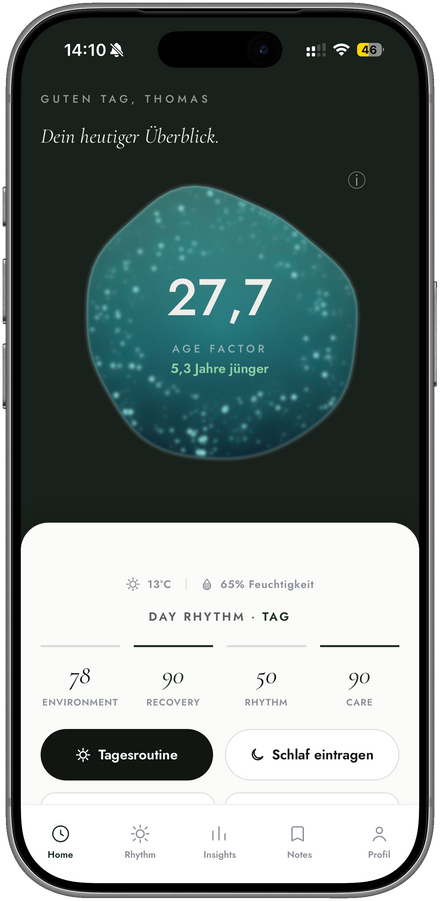
The chrono-biological logic of skincare — protection and moisture binding during the day, regenerative active ingredients at night — creates a framework in which stability cannot be viewed in isolation. The Porcelain Skin Serum accompanies the day rhythm with ingredients like pullulan, two forms of hyaluronic acid, Kigelia extract with bioactive flavonoids, amino-acid-based compounds, functional silk polypeptides, and licorice root extract — formulated for moisture retention, barrier function, and skin structure. For the nighttime phase, the Blue Crystal Drops facial oil contains bioactive phytosterols, vitamin C, bisabolol, and essential oils of blue lotus and blue tansy — geared toward nocturnal regeneration, antioxidant protection, and a caring film. Those who wish to consistently serve both phases will find a structured entry into rhythm-based care with The Perfect Duo. Background information on the chronobiological logic behind this is provided on the Chronobiology of the skin page.
For specific skin concerns — such as persistent irritation — a medical assessment should be obtained.
Frequently asked questions
How do I know if an active ingredient in my ampoule has already degraded?
Visual cues can include discoloration (typically browning with vitamin C), clouding of an originally clear formulation, or a change in consistency. Odor changes — especially rancid notes — can indicate the oxidation of unsaturated fatty acids. These signs are not present in all active ingredients; a degraded formulation may appear sensorially unchanged. Basically: take the PAO label seriously and, when in doubt, start with a fresh unit.
Can I store ampoules in the refrigerator to extend their stability?
For most oxidation-sensitive ingredients (especially L-ascorbic acid, retinol, certain peptides), cooling at 4–8 °C can slow down degradation kinetics. However, emulsion formulations and oils should only be refrigerated if the manufacturer explicitly recommends it — freezing or excessive cooling can impair the physical stability of the formulation. When in doubt, apply the following: store away from light at room temperature below 20 °C and close consistently after every use.
How do I distinguish true skin acclimation from active ingredient degradation?
A practical heuristic: If a freshly opened ampoule of the same product shows the same subjectively lower effect as the last unit, this points more toward tachyphylaxis or a normalized skin level (the skin has "recovered" and therefore changes less noticeably). If, on the other hand, the new ampoule shows the initial impression of intensity again, the declining effect of the old ampoule was likely formulation-related. This simple self-test is not scientific proof, but it is a helpful starting point.
Are multi-opening ampoules generally more problematic than single doses?
Not necessarily — it depends crucially on the preservative system, the closure mechanism, and the oxygen barrier of the packaging. Ampoules with a nitrogen blanket, high-quality rubber stoppers, and dark glass can maintain stable active ingredients despite being used multiple times. Conversely, a poorly preserved single dose can also degrade if stored improperly. Packaging quality and individual usage habits are at least as decisive as the format itself.
- Pinnell S.R. et al. (2001). Topical L-ascorbic acid: percutaneous absorption studies. Dermatologic Surgery, 27(2), 137–142.
- Kamm A. & Przybyłowska M. (2020). Stability of cosmetic emulsions: the influence of temperature cycling. Journal of Cosmetic Science, 71(3), 183–196.
- Łopaciuk A. & Łoboda M. (2013). Global beauty industry trends in the 21st century. Management, Knowledge and Learning International Conference Proceedings, 1079–1087. [Context source market format]
- Thiele J.J. & Ekanayake-Mudiyanselage S. (2007). Vitamin E in human skin: organ-specific physiology and considerations for its use in dermatology. Molecular Aspects of Medicine, 28(5–6), 646–667.
- Cosmetics Europe (2019). Guidelines on stability testing of cosmetic products. Cosmetics Europe Technical Guideline, Version 2, Brussels.
This article is for informational purposes only and does not constitute medical advice. For specific skin concerns, we recommend consulting a dermatologist.


