


Progress Review
— Why Patterns Only Speak After 30–90 Days
Skin changes in biological cycles, not in days. A structured monthly review makes epidermal turnover patterns and dermal remodeling processes visible — and replaces guesswork with verifiable observation.
Anyone who consistently follows a skincare routine expects results — but skin speaks in weeks, not days. Visible changes in texture, smoothness, and moisture balance follow biological cycles that can only be meaningfully assessed over 30 to 90 days. A structured monthly review makes these gradual patterns visible and helps adjust skincare routines based on data.
This principle is rooted in physiology: The epidermal renewal rate in adults is approximately 28–40 days, while dermal remodeling processes — collagen reorganization, fibroblast activity — span periods of 60–90 days or longer. A single observation after one week therefore provides statistical noise, not a signal. Only the comparison of snapshots over several cycles allows for evidence-based conclusions about efficacy and tolerability.
Epidermal turnover, collagen remodeling, circadian regulation — three timeframes, one overall picture
Skin changes occur simultaneously across at least three biological timescales. Anyone who only focuses on one of them interprets partial results as the overall picture — and draws premature conclusions. The following overview assigns the most important processes to their realistic observation periods.
Keratinocytes migrate from the basal layer to the stratum corneum and are shed there as corneocytes — a cycle that takes about four weeks under optimal conditions, and up to six in older skin or stressed skin barriers. The first changes in texture and smoothness can be documented in the literature from week 3–4, with stable patterns only from week 6–8. A 30-day photo comparison captures exactly this first turning point.
Fibroblasts synthesize collagen and elastin in response to mechanical stimuli, growth factors, and altered skincare conditions. In clinical studies on the topical application of bioactive substances, significant changes in dermal density are often only detected after 8–12 weeks using ultrasonography or biopsy. The 90-day review is therefore the actual measurement point for structural improvements.
The skin barrier is subject to a circadian rhythm: transepidermal water loss (TEWL) and lipid synthesis vary over 24 hours, controlled by peripheral clock genes such as CLOCK and BMAL1. This rhythm influences how the skin reacts to active ingredients — and explains why the separation of day and night care is not a marketing decision, but chronobiologically justified. Progress reviews should therefore also capture sleep quality and the time of application as variables.
Four typical progression patterns between day 30 and day 90
A monthly progress review is not an optional feature, but a scientific method: It separates noise from signal, external variables from product effect, and short-term adaptation from long-term structural improvement. Anyone who captures three data points on days 30, 60, and 90 has a reliable basis for evidence-based decisions about routine, active ingredient sequence, and adjustment needs.
Review protocol: What favors progress, what distorts it
- Standardized photo documentation: same camera, same lighting (e.g., daylight without direct sunlight), no filter
- Daily 10-second journal: feeling of tightness, redness, smoothing impression — numerically rated (1–5)
- Maintain the routine for at least 60 days before adjusting, to fully complete adaptation phases
- Introducing several new active ingredients simultaneously — makes it causally impossible to attribute which product creates which effect
- Subjective daily assessment without documentation: memory smooths out progressions and overwrites early snapshots
- Ignoring external variables (travel, climate changes, hormonal fluctuations) in the review protocol
The Porcelain Skin Serum accompanies the day rhythm with pullulan, two forms of hyaluronic acid, Kigelia extract (bioactive flavonoids), amino acid-based active ingredients, functional silk polypeptides, and marshmallow root extract — focused on moisture retention, barrier function, and skin structure. Anyone who keeps a monthly review can observe how exactly these parameters develop over 30-day windows. The night belongs to the Blue Crystal Drops face oil: with bioactive phytosterols, vitamin C, bisabolol, as well as essential oils from blue lotus and blue iris, it supports nighttime regeneration, antioxidant protection, and a protective care film — a process that also only becomes apparent over several cycles in the documentation. The rhythm logic underlying product development is described in detail in the area of Chronobiology of the Skin; anyone who understands the biological rhythm and its effects on skincare gains the right interpretive framework for their own review.
For specific skin concerns — such as persistent irritation — a professional medical assessment should be sought.
Frequently asked questions
When are the first changes from a new routine realistically visible?
In dermatological literature, the first measurable texture changes from topical application are often described from week 3–4 — so around day 21–28. This corresponds to one complete epidermal renewal cycle. Subjectively perceivable changes (softness, feeling of moisture) can occur as early as the first week, but are not yet an indication of structural efficacy.
How should a meaningful progress photo be taken?
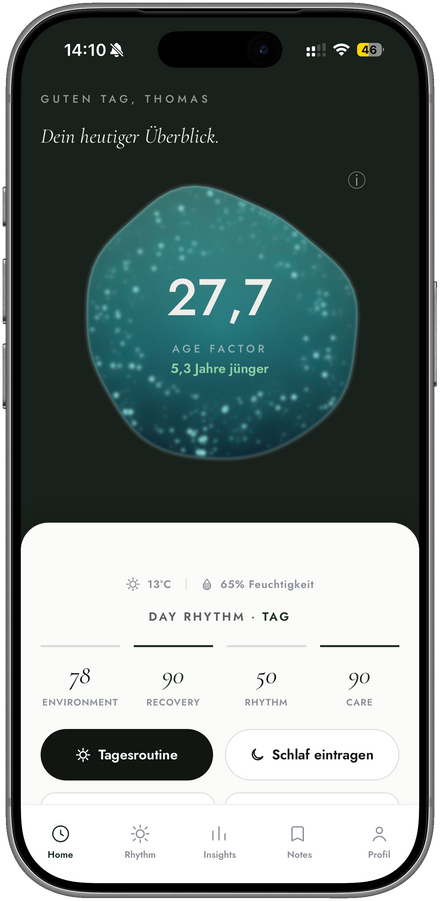
Reproducible conditions are crucial: the same device, the same room with even daylight (no direct sunlight, no artificial light source from the side), no makeup, identical distance and angle to the camera. Ideally in the morning before skincare — after cleansing, but before applying products. Some apps (e.g., those with face tracking) can help standardize the image crop.
What to do if no change is visible after 30 days?
First check whether external factors (travel, sleep deprivation, seasonal changes, hormonal phases) have influenced the period. Then honestly evaluate the consistency of application: Was the routine actually followed daily? Only when both points are ruled out does an adjustment make sense — and even then, another 30-day window with the adjusted routine is recommended before comparing again.
Can I test several new products at the same time and still document meaningfully?
From a scientific point of view, the parallel introduction of several unknown variables is problematic: An observed effect cannot then be attributed to any single product — neither positively nor negatively. A sequential approach is recommended: introduce new products individually over 30–60 days each. Anyone who expands an existing routine with a single element can assess its contribution much more clearly in the review.
- Weinstein, G. D. & McCullough, J. L. (1984). Cytokinetic basis for understanding and treatment of psoriasis. Journal of Investigative Dermatology, 83(1 Suppl), 26s–32s.
- Proksch, E., Brandner, J. M. & Jensen, J. M. (2008). The skin: an indispensable barrier. Experimental Dermatology, 17(12), 1063–1072.
- Plikus, M. V., Van Spyk, E. N., Pham, K., Geyfman, M., Kumar, V., Takahashi, J. S. & Andersen, B. (2015). The circadian clock in skin: implications for adult stem cells, tissue regeneration, cancer, aging, and immunity. Journal of Biological Rhythms, 30(3), 163–182.
- Mukherjee, S., Date, A., Patravale, V., Korting, H. C., Roeder, A. & Weindl, G. (2006). Retinoids in the treatment of skin aging: an overview of clinical efficacy and safety. Clinical Interventions in Aging, 1(4), 327–348.
- Rawlings, A. V. & Harding, C. R. (2004). Moisturization and skin barrier function. Dermatologic Therapy, 17(Suppl 1), 43–48.
This article is for informational purposes only and does not constitute medical advice. For specific skin concerns, we recommend consulting a dermatologist.


