

Skin Atlas
Definition & Application
An archive of mapped terms.
Classified within the context of modern skincare.
Tachyphylaxis Prevention in Retinoids: Pulsing Regimens vs. Dose Modulation
In cosmetics, tachyphylaxis prevention in retinoids means the targeted avoidance of diminishing efficacy due to habituation to continuous retinoid therapy, by either employing structured pulsing intervals (e.g., 5 days on, 2 days off) or gradual dose adjustment—without changing the active ingredient itself. Both strategies aim to delay receptor desensitization and minimize tolerance effects in the long term.
CONTENTS
Term and Origin
The term Tachyphylaxis comes from Greek: tachys (fast) and phylaxis (protection, defense). In pharmacology, it describes the rapid decrease in the response of a biological system to a repeatedly administered substance—independent of a classical immune response. In the dermatological context, the phenomenon was first described for topical corticosteroids before being transferred to retinoids. As early as the 1980s, researchers observed that tretinoin-induced epidermal changes—cell proliferation, collagen synthesis, corneocyte normalization—could diminish in intensity after months of continuous use.
The scientific debate surrounding retinoid tachyphylaxis is ongoing. Some studies demonstrate a measurable reduction in the gene expression of retinoid-responsive elements (RAREs) with continuous exposure, while other works relativize the clinical relevance of this effect. However, it is undeniable that long-term users frequently report a subjective change in efficacy—a finding that motivates the search for preventive strategies.
Characteristics & Mechanism of Action
Retinoids exert their effects by binding to nuclear receptors of the RAR (Retinoic Acid Receptor) and RXR (Retinoid X Receptor) families, which, as transcription factors, regulate the expression of numerous target genes. With continuous retinoid exposure, downregulation of these receptors—especially RAR-γ, which predominates in the epidermis—can dampen the cellular response. Simultaneously, chronic retinoid exposure induces increased expression of CYP26 enzymes, which oxidatively degrade intracellular retinoic acid. Both mechanisms contribute to desensitization.
The two main counter-strategies differ fundamentally in their methodology: Pulsing regimens (e.g., 5-on/2-off, alternating daily, or seasonal breaks) allow for periodic recovery of the receptor system and a reduction in CYP26 activity without a change in concentration. Dose modulation, on the other hand, varies the retinoid concentration or frequency within a continuous application schedule—for example, by quarterly reducing to a lower concentration, followed by a gradual increase. Both approaches do not rely on changing the active ingredient and avoid interrupting the therapeutic continuum. Which strategy is superior depends individually on skin type, retinoid class, and treatment goal.
Another, often underestimated factor is barrier stability: retinoids increase epidermal turnover and can compromise barrier function with continuous use. A weakened stratum corneum in turn alters retinoid penetration kinetics and thus the efficacy profile—a feedback effect that physiologically justifies pulsing cycles. More on the function of the skin barrier can be found in the article Understanding the Skin Barrier and in the overview of Skin Barrier as the New Luxury.
Skincare Approach
In practice, the 5-on/2-off regimen has established itself as a pragmatic entry into a structured pulsing regimen: the retinoid is applied for five consecutive days, then paused for two days. This corresponds to a weekly pause share of approx. 29%—high enough to cyclically relieve receptor systems, low enough to maintain the therapeutic effect. Alternatively, daily alternating regimens (every other day) or monthly dephasing weeks are discussed; clinical evidence for the superiority of a specific pattern is currently lacking.
Dose modulation without changing the active ingredient is particularly suitable for users who tolerate a high retinoid concentration but notice a decrease in efficacy after several months of continuous therapy. A short-term reduction to a lower concentration (e.g., from 0.1% to 0.025% tretinoin for 4–6 weeks) can be sufficient to restore receptor sensitivity. It is important to consistently maintain the accompanying routine: moisturizers and ceramides should be consistently used during pulsing and dose modulation phases to buffer barrier losses.
Additionally, retinoid-free interval active ingredients are discussed in the scientific literature—such as bakuchiol, which is considered a plant-based alternative with a different mechanism of action and a more favorable irritation profile, or AHA exfoliants to maintain cell turnover during pulsing phases. For users exploring marine alternatives, the article Algae-Based Bioretinol Alternatives provides a scientifically sound overview. Fundamentally, tachyphylaxis management is an application topic inseparable from the skin's circadian rhythm—for this, the entry Skin Chronobiology is recommended.
The combination of retinoids with oxidatively unstable active ingredients is a separate formulation topic; the article Benzoyl Peroxide & Retinol: Oxidative Inactivation covers corresponding spacing strategies in detail.
Realistic Expectations
Tachyphylaxis prevention is not a guarantee of consistently sustained efficacy but a strategy to slow down the habituation effect. Clinical observations suggest that structured pulsing cycles can extend the time until a noticeable decrease in efficacy—however, robust RCT data with direct comparison of different regimens are scarce. Individual variation plays a significant role: genetic differences in RAR expression, skin type, UV exposure, and concomitant care influence the rate of desensitization.
Users should also differentiate between true tachyphylaxis and other causes of perceived decrease in efficacy: formulation degradation (retinol oxidizes with improper storage), seasonal barrier changes, or the fact that certain target parameters (e.g., initial texture improvement) have a natural plateau effect can produce similar experiences. A dermatological assessment is advisable before any self-initiated escalation of the treatment regimen.
Frequently Asked Questions
Is retinoid tachyphylaxis scientifically proven?
The evidence is nuanced. Mechanistically, the downregulation of RAR-γ and the upregulation of CYP26 enzymes with continuous retinoid exposure are well documented in cell culture and animal models. Human clinical studies that directly attribute a measurable, clinically relevant decrease in efficacy over longer treatment durations to tachyphylaxis are sparse and methodologically heterogeneous. The frequently cited clinical observation of "exhaustion" of the retinoid effect has not yet found consistent histological or biomolecular correlates in large controlled studies.
Which pulsing regimen is most effective?
A direct comparison of the efficacy of different regimens (5-on/2-off, every other day, monthly breaks) in controlled studies is lacking. The 5-on/2-off regimen is widely used in dermatological practice because it is easy to implement and largely maintains the therapeutic continuum effect. Dose modulation—short-term concentration reduction without changing the active ingredient—is preferred for patients who do not tolerate a complete break or are therapeutically dependent on high concentration levels. The choice should be individually coordinated with a dermatologist.
Do all skincare products need to be changed during pause days?
No. The basic routine—especially moisturizing and barrier-stabilizing care—should be consistently continued during pulsing intervals. Particularly on pause days, the epidermal barrier recovers, which can be actively supported by appropriate moisturizing care. Products with exfoliating effects or other keratolytically active ingredients should only be used cautiously during these intervals to avoid additive irritation.
Conclusion
Tachyphylaxis prevention in continuous retinoid therapy is a pharmacodynamically justified concept with increasing relevance in evidence-based skincare. Pulsing regimens like the 5-on/2-off schedule and dose modulation without changing the active ingredient represent complementary strategies that—individually tailored—can help maintain the long-term efficacy of topical retinoids. Crucially, pulsing phases should not be understood as therapeutic gaps, but as an active component of a rhythmic skincare concept. Embedding it in a chronobiologically informed routine, as described in Skin Chronobiology, provides a conceptual foundation for retinoid therapy management that goes beyond mere active ingredient optimization.
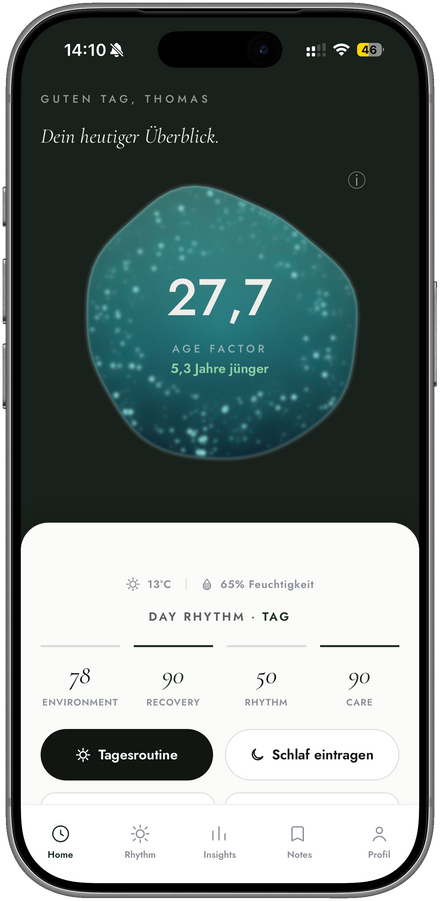
NATURFACTOR® — The Science of Rhythm — pursues a rhythm-based logic in its skincare approach, differentiating between day and night phases. The Porcelain Skin Serum is designed as a Day Rhythm for daytime care and integrates pullulan, two forms of hyaluronic acid, kigelia extract with bioactive flavonoids, amino acid-based active ingredients, functional silk polypeptides, and licorice root extract to support moisture binding, barrier function, and skin structure. The Blue Crystal Drops are a facial oil for the night—Night Rhythm—with bioactive phytosterols, vitamin C, bisabolol, and essential oils of blue lotus and blue tansy for nightly regeneration, antioxidant protection, and a protective care film. Since neither product contains retinoids, they structurally complement retinoid-based therapy protocols without interfering with their mechanism of action. The fundamental rhythmic logic of the approach is further detailed under Skin Chronobiology. Both products are also available together as The Perfect Duo—serum for day and facial oil for night.
- Mukherjee S, Date A, Patravale V, Korting HC, Roeder A, Weindl G (2006). Retinoids in the treatment of skin aging: an overview of clinical efficacy and safety. Clinical Interventions in Aging, 1(4), 327–348.
- Fisher GJ, Datta SC, Talwar HS, Wang ZQ, Varani J, Kang S, Voorhees JJ (1996). Molecular basis of sun-induced premature skin ageing and retinoid antagonism. Nature, 379(6563), 335–339.
- Törmä H, Vahlquist A (1990). Vitamin A esterification in human epidermis: a relation to keratinocyte differentiation. Journal of Investigative Dermatology, 94(1), 132–138.
- Kang S, Voorhees JJ (1999). Photoaging therapy with topical tretinoin: an evidence-based analysis. Journal of the American Academy of Dermatology, 41(3 Pt 2), S55–S60.
- White GM (1998). Tachyphylaxis with topical steroids: an overview. Journal of the American Academy of Dermatology, 39(4), S114–S117.
This article is for informational purposes only and does not constitute medical advice. For specific skin concerns, we recommend consulting a dermatologist.


